It is a universally accepted fact that one of the primary jobs of a parent is to nag your kids ad nauseam about saying “please” and “thank you.” They demand a cookie; you reply sing-songingly “What’s the magic word?” They beg to open birthday gifts; you interject a rhythmic “Well, what do you say?” after each is torn into and tossed aside.
Given my constant chorus of sometimes gentle, more times exasperated reminders, it irks me that my boys still forget to utter these common courtesies on a daily basis. Why is it they can’t recall these simple phrases they learned and even signed with their cute, pudgy hands as infants?
The lack of thanks especially bothers me. How have they grown into such gimme gremlins who expect milk to be served on tap and my phone to be accessed anytime for whatever random, nonsensical questions they want to ask Siri? It’s not like we’ve raised them in a day spa equipped with silver spoons and bunk bedside service.
Amidst this aggravation, it hit me that my incredulity at my sons’ ingratitude should be tempered by the knowledge that a) they’re 6- and 4-years-old; b) all kids can act ill-mannered at times and are by nature whiners; c) I do my best to provide a wealth of love and meet their basic needs, so of course they’ve become accustomed to abundant care and can occasionally take it for granted; and, most strikingly, d) I’m much worse at giving thanks than they are.
This conviction recently latched onto me and pierced my heart down to its most prideful parts. A single, frank comment posed in response to a sarcastic statement I made on social media cut my tongue right through to the cheek: “You should count your blessings.”
Oof. That stings, and spins so many self-incriminating wheels turning: Am I truly ungrateful? Have I fallen into complacent indifference to this bountiful life God has given me? Do I frequently fail to praise Him for the grace upon grace He provides every day? Has my preoccupation with perceived shortfalls eclipsed my appreciation for tangible windfalls – my husband, my children, my friends, my home?
In deed and in word, I can be ungrateful at times, and far too often, my numerous blessings go uncounted. Even though my heart recognizes the need for and importance of giving thanks, my mind habitually forgets to express it, to my own detriment.
In her latest book, “The Broken Way,” Ann Voskamp conveys the risk we take maintaining this gaping mental lapse: “Whenever I forget, fear walks in … Forget to give thanks – and you forget who God is. Forget to break and give – and it’s your soul that gets broken.”
When we forget to thank God, we lose our grip on the reality of our relationship – the essence of our lives’ dependence on Him – a kind of fatal spiritual amnesia.
How could we be so dense as to blank out on these truths? Perhaps we can blame our biology.
Thankfulness should theoretically be stored in long-term memory, which is permanent but requires conscious thought and is subject to weakening over time. Forgetting from long-term memory can be explained through retrieval failure – as one professor of psychiatry and aging described in an article on tip-of-the-tongue phenomenon (i.e., brain farts): “… if you don’t retrieve a memory often, it may be harder to remember. You know you have it somewhere, but you just haven’t used the information for a while. It gets a little a bit dusty.”
Lord knows how dusty-headed and absentminded His people can be, which could be why He repeats the concept of thanks more than 200 times throughout Scripture (according to KJV Hebrew and Greek concordances). In the Old Testament, “thank” appears most frequently as yahdah, which literally means to use the hand; to throw – think: hands extended in praise and confession. In the New Testament, it often shows up as eucharisteo, from the roots eu = good/well + charis = grace, as in Colossians 3:17: “And whatever you do, whether in word or deed, do it all in the name of the Lord Jesus, giving thanks to God the Father through him.”
In whatever we do, we must do whatever it takes to remember to thank God, to thank others, to live with hands outspread in thanksgiving for our redemption. Our Father has faithfully provided reminders throughout His Word to cue gratitude: through the aromas and rituals of thank offerings and Passover, through songs and hymns of praise, through the breaking of bread and pouring of wine in remembrance of the Cross.
As Voskamp intones, like a doxology, “the eucharisteo, then koinonia”: “Everything He embodied in the Last Supper – it is what would heal the body’s brokenness. Brokenness can be healed in re-membering. Remembering our union, our communion, our koinonia, with Christ.”
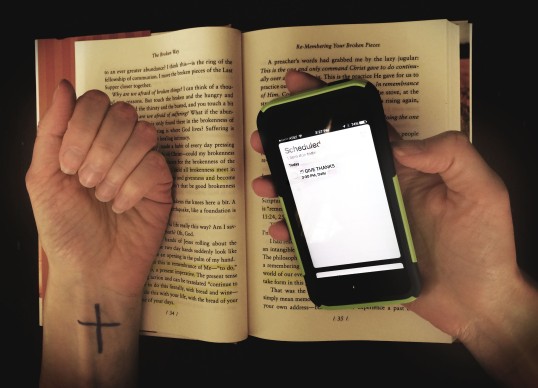
This is Truth worth committing to memory. It is a commitment, and because we’re human, requires reminders – whether that’s a note on the mirror, a notification on a phone, a song, a smell, a memento or alert of some kind – whatever signal or process that can help jog our memories of our undeserved grace and trigger the flow of our praise.
I’m still figuring out the best way to do this. Maybe I’ll recruit my boys to aid me in this effort and repay me for all the nagging I do to them. I can hear them now, chanting wholeheartedly: “Mom-my, you forgot to say thank-you.”
Nice reminder, kids. Irritating, but necessary, and vital for living life to the fullest.






 jennhesse.com